After two years in university,ı have met mass transfer.'have met' because ı havent pass the exams of this lessons that is seem easy but there are comlicated problems and solutions..particuls are passing air,water and solid surfaces and u solve and find parameters values.fabrics release their toxic gases and u find when will the gas be in x meter and differantions..
there are some screen of this lessons notes ı want to show:
A diffusion problem that occurs in the field of microelectronics is the oxidation of silicon according to the reaction Si + O2
 SiO2. Consider the the oxidation of a material M given by the general reaction M + (1/2)x O2 MOx (with x = 2 for silicon oxidation). When a slab of the material is exposed to gaseous oxygen (species A), the oxygen undergoes a first-order reaction with rate constant k1" to produce a layer of the oxide (species B). The task is to predict the thickness d of the very slowly-growing oxide layer as a function of time t using a quasi-steady-state approach (which suggests that the rate of change of the dissolved oxygen content in the layer is small compared to the rate of reaction). Let the oxygen, whose dissolved concentration is cA0 at the free surface of the oxide layer at z = 0, diffuse through the layer as per Fick's law to reach the reaction surface at z = d as in the figure below.
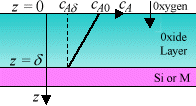 Figure. Diffusion of oxygen through an oxide layer formed by oxidation of silicon.
b) Find the concentration profile of oxygen in the layer at steady-state.
c) Using quasi-steady-state arguments, show that the oxygen concentration at the reaction plane (z = d) is given by
 |
where DAB is the oxygen diffusivity through the oxide film and cB is the molar density of the oxide layer.
d) Derive an expression for the thickness of the very slowly-growing oxide layer when the quadratic term on the right-hand side of the above equation is negligible.
e) Reduce the above results for the limiting case of diffusion - controlled oxidation where the reaction rate constant k1" tends to infinity.
You can solve this problem ıf ı have free time..:)

Hiç yorum yok:
Yorum Gönder